From the first edition of The Eyes of Dead Dogs.
City at Dark
From the first edition of The Eyes of Dead Dogs.
God of Nature
From the first edition of The Eyes of Dead Dogs.
Passed Out Drunk at the Bar
The drawings in this collection are by Palestinian artist Muṣṭafā al-Ḥallāj. 1st edition of The Eyes of Dead Dogs.
The Eyes of Dead Dogs
Dear readers, please indulge me for the next long series of posts, in which we will bring you a long series of images from books of poetry by ʿAbd al-Wahhāb al-Bayātī, a favorite of ours here at ArtsandAdab.
This is the cover of ʿUyun al-kilāb al-mayyitah, 1st ed. (Bayrūt: Dār al-ʿAwdah, 1969). The UCLA Library's binder has unfortunately obscured the front cover when preparing the volume for shelving. Alḥamdulillāh the images on the inside pages are all visible and scannable!
Commitment and Sufism in ʿAbd al-Wahhāb al-Bayātī's Poetry
ʿAzīz al-Sayyid Jāsim's al-Iltizām wa-l-taṣawwuf fī shiʿr ʿAbd al-Wahhāb al-Bayātī 1st Ed. (Baghdād: Dār al-Shuʾūn al-Thaqāfiyyah al-ʿĀmmah, Āfāq ʿArabiyyah, 1990)
Crazy for Wine
Image 6 from Khayyām's Songs
The Iraqi poet ʿAbd al-Wahhād al-Bayātī also drew on the mythic al-Khayyām in his poetry. In his last collection (Eastern Texts [Nuṣūṣ sharqiyyah]), published in Damascus the year of his death, 1999, he wrote the following lines:
Al-Khayyām apologized for meeting me
at the Observatory,
in fear of the informers,
for he had been indicted for his religion,
and I
for kidnapping the Sultan’s daughter,
being crazy for wine,
and dancing naked under the starlight. (p. 76)
A Procession
Image 5 from Khayyām's Songs
A Cupbearer at a Wine Session
Image 4 from Khayyām's Songs
The Scientists
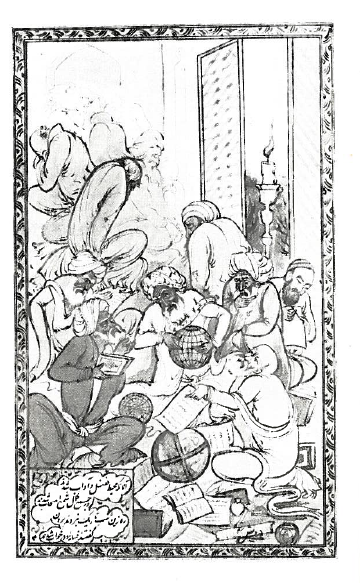
Image 3 from Khayyām's Songs
Perched on Ruins
Image 2 from Khayyām's Songs
Khayyam's Songs
Inset from Ṣādiq Hidāyat's Tarānah-hā-yi Khayyām, drawn by Darvīsh Naqqāsh ([Tihrān?]: Insishārāt-i Māh, [1982?]).
Hidāyat was the founder of Iranian literary modernity in prose, the novel-writing parallel to Nīmā Yūshīj the poet. However, unlike Nīmā, Hidāyat's view of modernity aligned more closely with that of the Pahlavi regime--anti-Islamic and anti-Arab, Hidāyat's modernity sought to recapitulate the Iranian past as singular and teleological, ending with a reconstituted ancient Iranian grandeur repurposed for the modern age. Hidāyat's project therefore included bringing pre-modern historical-mythical figures to life again. ʿUmar al-Khayyām (whose popularity had taken off in Europe following FitzGerald's translations in the 19th century) was a key personage for Hidāyat, who molded a version of a skeptical, rationalistic Khayyām to match his own anti-clericalism and Persian chauvinism. That our received version of Khayyām is most probably an historical fable cobbled together over time and ascribed with a whole corpus of Rubāʿiyyāt (four-line poems usually rhyming AABA) did figure into Hidāyat's reception, and he should be commended for at least considering the possibility of a mythical, a-historical idea of Khayyām the poet. (Khayyām the scientist might be another story.) We must also consider Hidāyat's troubled psychological disposition and racism when reading his version of Khayyām, whose verses he collected in this edition, reissued in 1982 in Tehran.
Adonis's A Bookseller Who Trades in Books of the Stars
Bayrūt : Dār al-Sāqī, 2008
A Lament for Hafiz al-Shirazi - A Woman and a Lover Made of Stone
A fourth drawing by ʿĀmir Rashād in al-Bayātī's Bukāʾiyyah ilā Ḥāfiẓ al-Shīrāzī.
Woman and a Gate - Lament for Hafiz al-Shirazi
A third drawing by ʿĀmir Rashād in al-Bayātī's 1998 collection, published in 1999.
A Woman - Lament for Hafiz al-Shirazi
Another image by ʿĀmir Rashād.
This could be al-Bayātī's Goddess of Rebirth, ʿĀʾishah ("Living Woman"), or perhaps it could be the mysterious Persian beloved, Furūzandah, to whom he dedicated the "Lament." Furūzandah was a fellow student of his at the Dār al-Muʿallimīn al-ʿĀliyah (The Teachers College) in Baghdad during the late 1940s. He only spoke of her in a couple of interviews towards the end of his life, telling friends that she was the daughter of the Iranian Cultural Attache in Baghdad--and that he was smitten with her. He carried her memory with him until the year he died (1999), dedicating this collection to her in October, 1998.
A Lament for Hafiz al-Shirazi - The Lovers
Drawing by ʿĀmir Rashād in al-Bayātī's 1998 Lament for Hafiz al-Shirazi, published the year the poet died, 1999.
A Lament for Hafiz al-Shirazi
This drawing is from the 1999 edition of the Bukāʾiyyah ilā Ḥāfiẓ al-Shīrāzī by ʿAbd al-Wahhab al-Bayātī, 1st ed. (Bayrūt: Dār al-Kunūz al-Adabiyyah).
The image was created by Muḥammad Tajwīdī, an Iranian artist. It was then copied by the Palestinian artist Bassām ʿAbd al-Salām Yūsuf.
Check our Twitter feed (@artsandadab) this week for some translated verses from the Bukāʾiyyah.